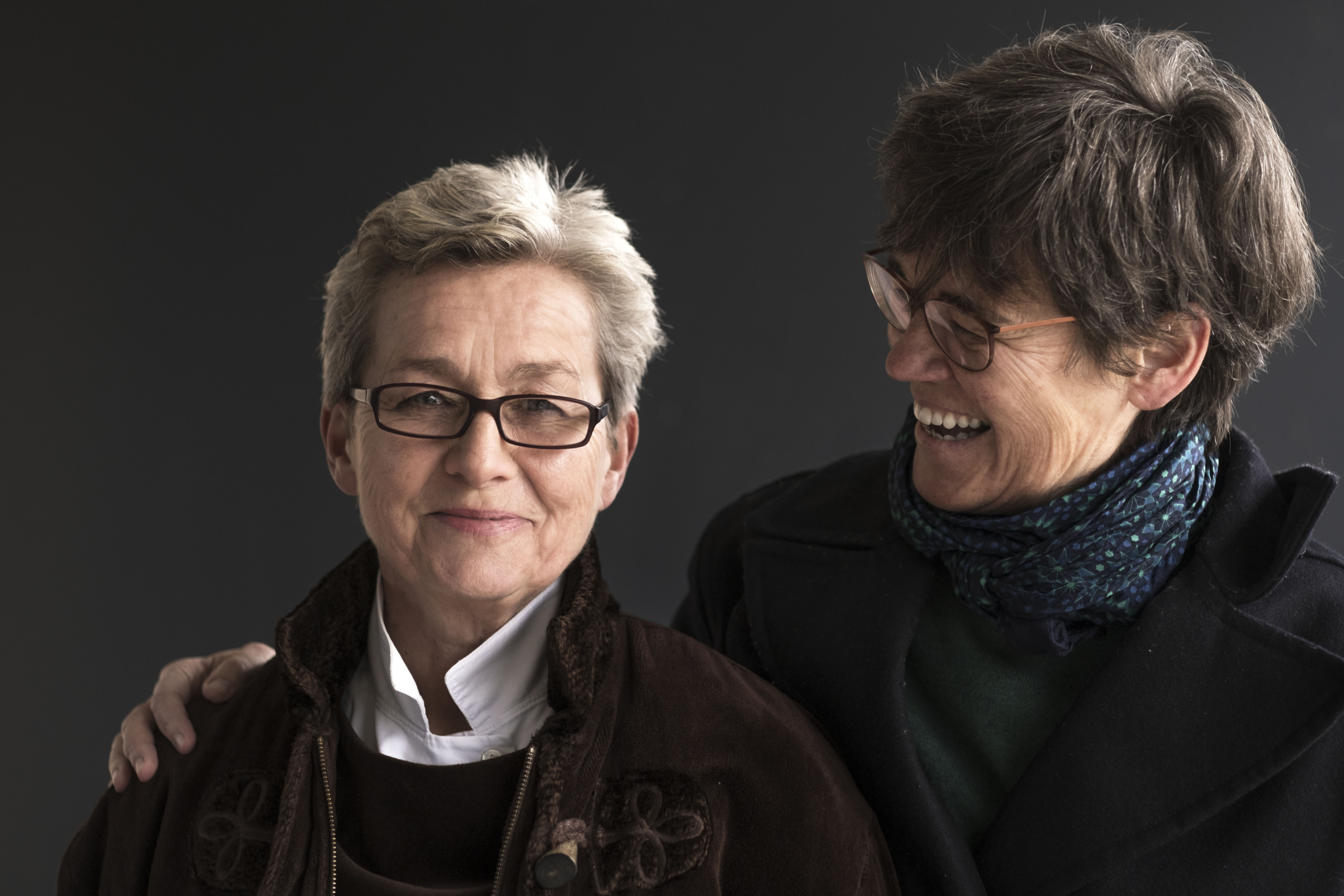
A portrait of three decades L’Orfeo Barockorchester with Michi Gaigg and Carin van Heerden
When L’Orfeo plays, music becomes language, dialogue, an exploring journey. „If you hear an orchestra on the radio, you recognise them straight away: that’s L’Orfeo! “– this sentence has long since become a common dictum in the Early Music scene. It describes a phenomenon which encompasses much more than mere stylistic principles. The orchestra and its founders, Michi Gaigg (violin) and Carin van Heerden (recorder, historical oboe), have created a sound DNA for three decades now in which curiosity, precision and bold creativity intermingle. This musical “home” is continuously developed and redefined and is carried by an ensemble which unites continuity and innovation. L’Orfeo is celebrating its 30th anniversary in 2026.
On the shapes of sound and musical speech
„Our music tells stories, to me that is the essence of our work “, Carin van Heerden comments. The central aim for L’Orfeo is to spell out a musical language, to differentiate colours and use articulation as part of a live grammar system. “The shapes of sound on a string instrument resemble the vowels of a language. If I use a fast bow the sound will probably remind us of the vowel E” Michi Gaigg explains. “In this aspect we consciously orientate towards the singers. A singer’s controlled air stream corresponds with the bowing speed of string players and the air speed of wind players. This creates an ensemble sound which breathes and speaks collectively.”
The result of this endeavour becomes audible straight away: the string players create vowels with their bowing technique while the wind players support these shapes with articulation and air speed, meticulously following what the string players dictate. “The exciting thing is that we wind players can observe exactly what the string players are doing and then translate it into our own language” Carin van Heerden adds. This results into true interaction. The wind players “can imitate the shapes of sound with their own fine dynamics”. A cumulative sound evolves which enhances the spectrum and is characterised by differentiated colours. To Carin van Heerden this collective and innovative strength poses “a unique way of thinking together, of experimentation and the possibility of creating music in a new way.”
Michi Gaigg is adamant about unfiltered, highly affected expression, even if it involves rough playing. “To me the affects and our own truthfulness are huge priorities. I also encourage rough and scratchy playing if the music demands it”, Gaigg explains. Often outdated ideals of beauty are consciously questioned. A sound engineer from the West German Radio once remarked: “This is by no means beautiful playing anymore!”. For Gaigg and Van Heerden this was the highest compliment!
Rehearsals equalling an imagined laboratory
L’Orfeo‘s creative laboratory is fed by mutual inspiration and the interlocking of ideas. The connection between strings and winds was practically inevitable, says Carin van Heerden, since they share the passion for sound and theoretical diversity. In the process of exchange there is ample opportunity to delve into matters such as articulation, colours, tension. “The wind players experience how the strings deal with colours – we respond with our own articulation, with our breath, dynamics and sometimes harsh percussive effects”. Michi Gaigg adds “my ideal would be to create the maximum dialogue possible, a mutual awareness and creative drive which is available any second.” This leads to perpetual new nuances and surprising perspectives. Interpretation for L’Orfeo is no rigid construction, it much rather remains flexible. Also, in a concert situation the music itself is negotiated afresh, remains alive, open and risky.
This attitude not only influences the playing but also shapes the atmosphere during rehearsals. To communicate implies to be able to deal with differences, to allow for conflicts and to create space for resonance. This mutual search, both musicians are convinced, is based on a natural principle: a strong trust and connectivity among the members coupled with risk and creativity. „L’Orfeo’s strength is derived from the balance of risk and trust, from the courage to allow diversity and the curiosity to see what happens next.“
Crossing borders, taking risks, plurality
L’Orfeo’s repertoire includes Telemann and Rameau via Bach, the Galant style including the Mannheimer School’s eagerness to experiment, the expressive Sturm und Drang up to Mozart, Schubert and Mendelssohn. “Our love for French Baroque music derives from the strong poetic connection between colours, language and dance. This influenced us strongly and opened new visions on approaching the works by Mozart, Haydn and Schubert,” Michi Gaigg and Carin van Heerden explain. “When the music of the Romantics ceases to “speak” and rather “paint” our instruments and our approach don’t fit any more. As long as language and architectural form remain binding for the music, we find that we can access these qualities very well with our instruments.”
L’Orfeo regards itself as a community which grows from different individual musical roots and biographies into a collective idiom. “Our international diversity, the richness of our lives’ journeys is the treasure that we feed on for our sound”, Michi Gaigg confirms.
Instruments as tools of knowledge, performance practice as field for experimentation
Gaigg and Van Heerden never regard historical instruments as museum artefacts, on the contrary. They are much rather tools for an inquiring approach. “We play music from the past if it speaks to us and if it inspires us mentally. This is the most important criterion and vehicle”, Michi Gaigg explains. Historical performance practice is a laboratory for crossing borders to the present and never a dogmatic given. “It remains a field for experimentation. We want to know what a work sounds like when we respect the possibilities and limitations of the original but always translated to here and now.”
Chamber music as an attitude: the L’Orfeo wind ensemble
An own space for chamber music developed in 2009 with the L’Orfeo wind ensemble. Directed by Carin van Heerden it transferred the conversational approach of the orchestra into chamber music in a flexible line-up. Again, the repertoire reaches from Baroque up to early Romantics, always with the appropriate historical instruments. One principle remains crucial: an awareness in chamber music which intensifies the orchestral approach. “We want to live the special approach of the orchestra in a chamber music setting” Carin van Heerden explains. This implies the flexible sound which one hears in the music by Telemann and classical and bohemian Harmoniemusik.
Knowledge in motion: education
The initial experiment in the ensemble led to a space of resonance in teaching. The Euridice Barockorchester was founded in 2013 at the Anton Bruckner Privatuniversität in Linz by Michi Gaigg and aspires to an attitude of connectedness. Sectional leaders of L’Orfeo are regularly included in various projects to work together with the students, offering guidance, always on eye level, maintaining curiosity. Gaigg adds that “this mutual work poses a huge enrichment for the students and a sustainable glance into the future for our members.”
Continuing the journey: sound as an adventure
What remains after thirty years? An ensemble which consistently relies on dialogue, openness and experiment. “Our aim is to remain susceptible for our own surprises. Each rehearsal, each concert is an experiment, an adventure with an uncertain outcome,” Carin van Heerden explains. L’Orfeo remains an experiment in sound, held by two visionaries whose artistic partnership unwaveringly taps new horizons, remaining curious, inspired and happy to take risks.
Pic (c) wal.pix